Remote monitoring: how connected devices reach your care team
12 June 2026 · By Healthtech.mu
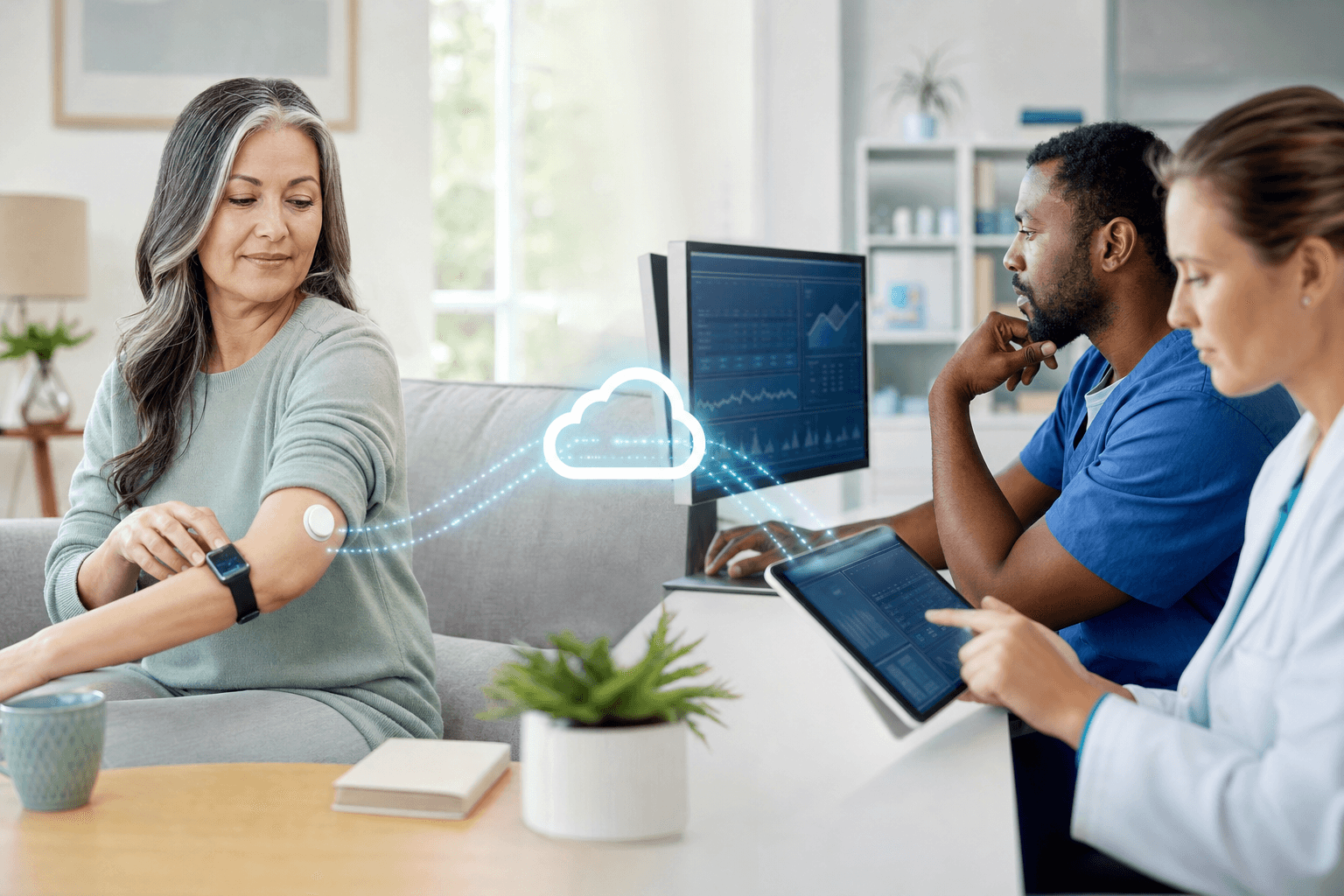
Care that follows you home
For a long time, health measurements only happened in a clinic. You visited, a reading was taken, and that single snapshot had to represent your whole month. Remote monitoring changes that picture. With connected devices, readings taken at home can travel, with your consent, to the people responsible for your care.
This is often called remote patient monitoring. It does not replace the clinic, but it fills in the long gaps between visits.
How it works in practice
The basic chain is simple, even when the technology behind it is sophisticated.
A device takes a reading
This might be a blood pressure cuff, a blood glucose meter, a weighing scale, a pulse oximeter or a heart monitor. You use it at home, often once or twice a day.
The reading is transmitted
Many modern devices connect to a phone app or a small hub using Bluetooth, then send the data securely over the internet. Some send readings automatically, while others ask you to confirm and submit them.
The care team reviews trends
Nurses or doctors see your readings on a dashboard, usually alongside set thresholds. If your numbers stay in a safe range, no action is needed. If a reading crosses a limit, or a worrying trend appears, the system can alert a clinician to get in touch.
The point is not to watch you every second. It is to catch meaningful change early, while there is still time to adjust treatment gently rather than in an emergency.
Who benefits most
Remote monitoring is especially useful for ongoing conditions that need steady management.
People with high blood pressure can have it tracked across many days, which gives a truer picture than a single, sometimes anxious, reading in a clinic. People living with diabetes can share glucose patterns so that medication and diet advice can be fine-tuned. Those with heart failure can be weighed daily, because sudden weight gain can be an early sign of fluid building up.
It also helps people for whom travel is hard, whether because of distance, mobility or work. In Mauritius, where specialist care clusters in particular regions, the ability to send readings rather than make repeated journeys can ease a real burden.
What to expect as a patient
If your care moves partly into your home, a few things change.
You take on a small, regular routine, such as measuring at a set time and keeping the device charged and within reach. The care team usually explains your target ranges so that you understand what a normal reading looks like for you.
You should also know what happens when a reading is out of range. A good programme tells you clearly: does the system alert someone automatically, or do you need to call? Knowing this prevents both panic and false reassurance.
Privacy and trust
Because remote monitoring involves your health data leaving the home, it is fair to ask where that data goes. You are entitled to know who can see your readings, how they are stored, and how to stop sharing if you wish. Reputable programmes use secure connections and limit access to the staff directly involved in your care. If anything about consent or data handling is unclear, ask before you enrol.
The human side still matters
A dashboard full of numbers is only as good as the response behind it. The best remote monitoring keeps a person at the other end, someone who calls when a trend looks wrong and who listens to how you actually feel, not just what the device reports.
Numbers and symptoms do not always agree. You might feel unwell while your readings look fine, or feel fine while a number drifts. Both are worth reporting. Remote monitoring adds information, but your own description of how you are doing remains essential.
A measured view
Remote monitoring is one of the quieter successes of health technology. It rarely makes headlines, yet it helps many people stay stable, avoid hospital stays and feel more secure at home.
If it is offered to you, treat it as a partnership. Keep up your part of the routine, ask questions about thresholds and privacy, and always raise new or worsening symptoms with your doctor rather than waiting for a device to notice.
Smart health technology supports a longer, healthier life. Explore the wider Medtech health ecosystem.